by Jan-Phillipp Weisswange
 |
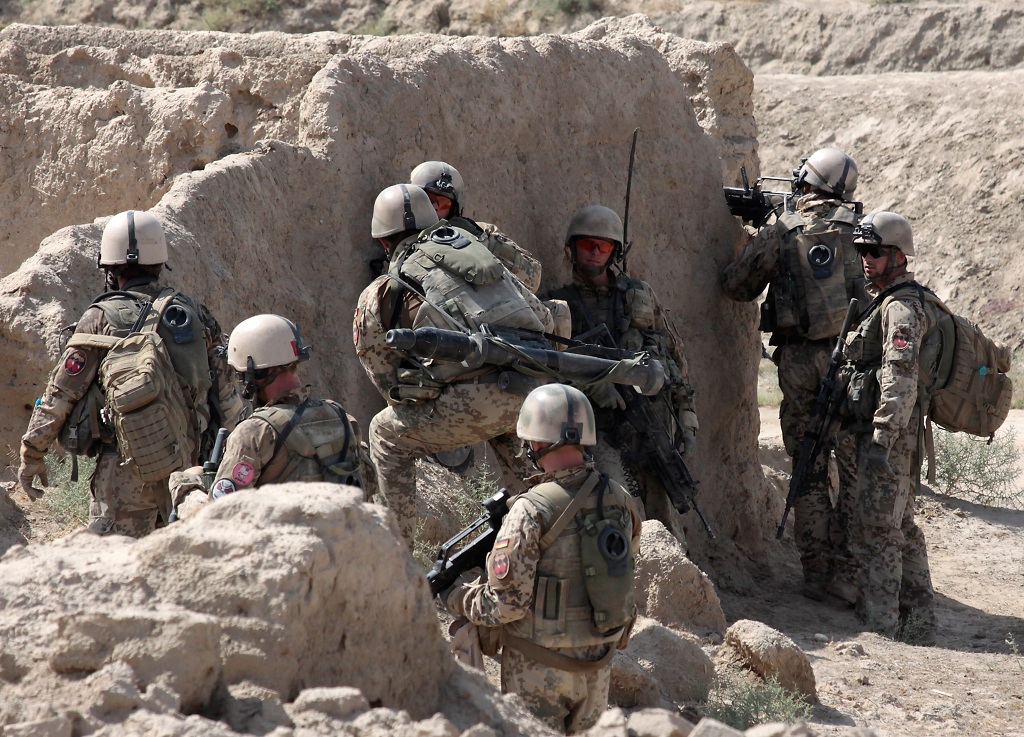
| German Infantry fighting in Urban Terrain in Afghanistan. Photo by Bundeswehr/Patrick v. Soehnen |
Firepower in Urban Operations is one of the most important aspects for performance in one of the most demanding tasks for infantry forces past and present. The success in urban warfare is not only a question of superior technological firepower, but first and foremost a question of superior intellectual firepower. The following article is based on my presentation held at the International Urban Operations conference of the German Association of Defense Technology in Berlin, February 1st 2012.
Basically when we talk about firepower in Urban Operations in the age of Network enabled Warfare it should be clear that thanks to Joint Fire Support the infantry can use a broad range of effectors: from the combat knife up to the 120 mm smooth bore tank gun, the 155 mm artillery shells as well as laser guided bombs or even cruise missiles launched from warships ashore.
 |
| IdZ-2. Picture: www.mittler-report.de |
The slide above shows the “Infanterist der Zukunft-2” Soldier System project’s components of the German Army. It gives you an impression of modern infantry equipment which is available today and will be fielded in the next years. Nearly all modern armed forces are working on similar projects to embed the “boots on the ground” in the Networked Enabled Warfare or “Vernetzte Operationsführung” as we call it in Germany. Of course, technologies develop rapidly, especially in terms of miniaturization, capabilities, performance, energy effectiveness and priceworthiness. So we will see a lot of modifications in the next years.
Notwithstanding the above I will have a closer look on the equipment which gives the infantry and the dismounted fighting warriors first and foremost firepower in urban operations. To do so I have chosen the following Agenda: In a first step I will recall some characteristics of urban operations and the conclusions derived from that. Then I will focus mainly on the effectors the infantry uses – or should use - in urban operations: Small Arms, handheld support weapons as hand grenades or underslung/stand alone grenade launchers and personal equipment.
Characteristics of Urban Operations
The term „Three Block War“ introduced by USMC General Charles C. Krulak to the international strategic community describes the complexity of urban operations on the strategical/operational level very accurate. Today‘s armed forces have to cope the parallelity of Humaniatrian Aid, Peace Stabilization Operations and high intensity warfare within the space of three city blocks.
 |
| Urban Terrain. Picture by U.S. Army |
Even on the tactical level the main characteristic of urban operations is the complexity of the theatre respectively the batttlefield:
- A high number of manoeuver elements, forces and even small sections have to be coordinated;
- Dead angles, scattered light etc. reduce the viewing conditions;
- broken lines of sight hamper reconnaissance and make it difficult to engage enemy forces;
- ricochets, collapsing buildings etc. intensify the effectiveness of weapons;
- infrastructure and obstacles limit the manoeuverability;
- the presence of civilian population increases the risk of collateral damage;
- C4I and High Tech often does not work properly and so it is limited usable.
Furthermore we often face asymmetric threats and – of course – IED’s and booby trapped windows and doors.
To achieve a full spectrum dominance on all escalation levels in this scenario, from the military commander‘s point of view we need first and foremost not only soldiers. We need highly motivated warriors with a combat mindset, a sense of responsibility as well as physical fit and highly trained.
SOF are required f. e. for ISTAR, SR, DA, C-IED, CRC
From the military technological point of view, we need:
- A full range of effectors from NLW up to high effective combat loads („Scaleable effectiveness“);
- arms with high precision and accuracy to avoid collateral damages;
- ABM/ASM/missiles to take out enemy strongholds or engage enemies behind walls/cover even on higher distances;
- anti structure ammunition and/or explosives to breech through walls (IDF: “Rizomatic Warfare”).
Last but not least we must follow the old military principle “Effectiveness before Cover!”
Small Arms: The “tool box approach”
Todays small arms concepts follow the “tool box” or – as our more sportive British comrades call it – the “golf bag approach”.
The range of the tools starts with the bayonet or fighting knife.
The next tool is the pistol carried as secondary armament for personnel defense or the use in constricted surroundings – f. e. in vehicles or in buildings.
The main armament for nearly every soldier is the assault rifle. In urban operations short or compact versions are more favorable because of the higher manoeuverability and mobility.
 |
| IdF-Infantryman with Tavor TAR-21. Photo: IDF |
In this context it is interesting that the IDF – which fought two campaigns in the past years in urban environment (Lebanon and Gaza Strip) – fields the Tavor TAR-21 Assault rifle. This weapon follows the bullpup design. The bullpup design offers without a doubt high mobility in constricted surroundings. However it requires a different handling training and the ejection of the cases could be a problem if the weapon is fired from the weak side – which is often necessary in urban warfare.
Sniper Rifles, Machine Guns, and handheld support weapons complete the „tool box“.
I will come back to that later.
Small Arms: Modularity
Modularity is not a trend any more – it has become standard.
Be it the “tool box approach” I have already mentioned, be it the weapon itself (G36 = Modular Assault Rifle System, FN SCAR), be it the add-on-components (SOPMOD Operator’s Kit) or be it the Personal Equipment (MOLLE = Modular lightweight Load-Carrying Equipment).
 |
| FN SCAR Family. Picture by FN/Military-Today |
Thanks to MIL-STD1913 or “Picatinny” rails the weapon configuration can be optimized for nearly all operations.
The following characteristics of urban operations should be regarded in this context:
The complex battlefield includes the fighting in buildings, basements or even in the canalization. Therefore, flashlights or Laser-Light-Modules (LLM) are definitely obligatory for assault rifles respectively the main armament carried ! LLM are also helpful for pistols but not a “must have”.
Because of the speed of action required for urban warfare fast aiming helps to win the firefight. Red Dot Optics like Aimpoint, Carl-Zeiss Optronics Reflex Sight for Small Arms, Elcan, EoTech, Trijicon etc. should be standard.
 |
| G36KA1.1 with ZO4x30, RSA-S and IRV600 by Carl Zeiss Optronics. Photo: Bundeswehr |
To avoid collateral damages a high accuracy is very essential. Hence, magnifiers for the optical sights or compact scopes like Schmidt & Bender 1-8 x 24 with an illuminated reticle can be helpful.
Modular Optical Aiming Systems f. e. the Carl Zeiss Optronics’ modular optic family built around the ZO 4x30i offer many advantages because of their tactical flexibility.
Optical Aiming Devices make also sense for the GPMG/SAW!
But don’t forget to preserve your shooting skills with back-up iron sights!
Machine Guns
The traditional German Approach of the “Einheitsmaschinengewehr” or “General Purpose Machine Gun” in my opinion is still suitable. This “Medium Machin Gun” can be used as a support weapon in the Infantry Section, as an air-defence-gun or even as a vehicle mounted solution. All soldiers are trained to operate this weapon and can replace the machine gunner if he should be out of action.
In Urban operations, the “light machine gun” or the “Squad Automatic Weapon” like the FN Minimi fielded in the early eighties or the German MG4 fielded in the beginning of this century offer tactical advantages. The operator can carry more ammunition which in addition comes in the same caliber as the cartridges fired with the standard assault rifle.
 |
| "Rotte" of two German Warriors armed with MP7 and MG4. Photo: Jan-P. Weisswange |
Also in urban operations the section is often splitted in two four-man fire teams consisting of two “buddy teams” (“Rotten”). Therefore, in Urban Operations two SAWs on section level can make more sense than one medium machine gun on section level. However, in respect to the “tool box approach” my solution would be one GPMG and one SAW on section level, so that we have one fire team with a GPMG-gunner and one with a SAW-gunner.
A medium machine gun with identical handling to the SAW would be an ideal solution – like the FN MAG and the FN Minimi. At present in Germany, the HK121 is under development. Its handling is nearly identical to the MG4. If it passes the testings it is likely that it will replace the MG3 which had been fielded as MG42 by the German Wehrmacht 70 years ago.
 |
| German Paratroopers during EUFOR RD Congo with MG3. Photo: Bundeswehr |
Until then the MG3 will stay in service. And to be honest: It still performs very, very well, even if some modernizations like optical sights, MIL-STD1913-Rails or a more ergonomic sling would be preferable.
The Search for the „Magic Bullet“?
A consideration of the small arms would be incomplete without mentioning the current debate concerning the calibres.
The current NATO Standard 5.56 x 45 mm cartridge has been fielded in 1980, but the first real baptism of fire occurred in the early nineties in Mogadiscio/Somalia. After Action Reports said that the 5.56 x 45 mm had not performed very well. Even nowadays there are complaints that the effectiveness is not sufficient, especially on longer distances.
Should we move back to the elder 7.62 x 51 mm as the standard ammunition?
To be honest: Personally I am a fan of the old NATO-cartridge because it offers more effect on the target and also a higher accuracy even on longer distances.
With regard to Urban Operations however I tend to say that the 5.56 x 45 mm is may be the better option for the regular soldier carrying an assault rifle. The firefights usually occur on shorter distances less than 200 metres. And a lot of ammunition is needed for the fight on shorter distances or even up to point blank range. And at the same weight level a soldier can carry much more 5.56 than 7.62.
 |
| PCP .300 WinMag-Ammunition with Polymer Case. Photo by Jan-P. Weisswange |
Polymer cases can help to reducing the weight of ammunition, but functional testings are not completed yet. And even when the weight of the 7.62 ammo can be reduced to the 5.56 level, a 5.56 magazine can hold 10 more cartridges than a 7.62 magazine.
Of course, the 5.56 x 45 is not the one and only universal ammunition in urban operations. The whole set of tools out of the infantry toolbox must be deployed in urban operation as well.
To increase the firepower of the infantry section most armed forces have fielded so called “Designated Marksman Rifles” or DMR in the old NATO caliber 7.62 x 51 mm to engage enemies on distances up to 600 metres. And finally we have Sniper Rifles in .300 Win Mag or the more and more popular .338 Lapua Magnum as well as Anti-Material Rifles in .50 BMG for targets in distances up to 1.800 metres.
There is another big discussion related to the ammunition: the debate about the “incapacitation”. Of course, an ammunition with a defined release of energy (Definierte Energieabgabe/DEA) like many police forces have in service would be preferable even in military urban operations.
However it is common opinion at least in Europe that because of the Hague Convention most western armed forces are allowed to use Full Metal Jacket-bullets for their small arms only. Even the new M855A1 cartridge fielded by the U.S. Army is not regarded as a FMJ bullet.
 |
| Different types of current and experimental cartridges. Picture by Airborne-Combat-Engineer.com |
At the moment there are attempts to create a new NATO standard cartridge which combines accuracy, effectiveness, range and incapacitation. Some examples are the 6.8 Remington Special or the .300 AAC blackout. I also recommend to consider the old German 7,92 x 33 mm. Its parameters are: bullet weight = 8.1 grams/125 grains, muzzle velocity = 690 m/s, muzzle energy = 1.900 J, effective range: 400 metres. But even when a new standard NATO Cartridge will be fielded we will still need the complete set of the toolbox. At least as long as we do not have series-production readiness for “Magic bullets”.
Handheld Support Weapons
Hand grenades and 40 mm Ammunition for stand-alone/underslung grenade launchers are the main support weapons carried by the infantry. Both types of handheld support weapons offer a wide range from NLW up to high efficienct combat loads.
 |
| Designated Grenade Gunner with Rheinmetall Hydra. Photo: MilPictures/Rheinmetall |
The new 40 x 46 mm Medium Velocity ammunition will increase this firepower more and more. This offers a great amount of tactical flexibility. It is likely that after the “Designated Marksman” the infantry section will get the “Designated Grenade Gunner” in future structures.
Air Burst technology comes close to the “Magic bullet”.It will play a more and more important role to engage enemy forces behind cover.
Anti Structure Ammunition is needed to destroy enemy strongholds, machine gun positins et cetera. It can also be used to create entries through walls so that booby trapped doors and windows can be avoided.
Unmanned Aerial Systems able to loiter in the airspace over the urban battlefield can also reinforce the ISTAR-assets and can engage enemy targets on demand.
Last but not least infantry missiles can be deployed to destroy enemy strongholds on distances up to 3 km.
Personal Equipment
On the urban battlefield, warriors have to be highly manoeuverable. They have to scale obstacles, climb walls, crawl through holes in walls. However, they can easily find cover behind walls, debris etc.
Therefore I think it is obvious that it does not make much sense to use heavy body armour. Mobility also offers a high amount of protection.
 |
IDF-Paras conducting the "Rizomatic Warfare" during Operation Miwtza Oferet Jetzuka 2008/2009 in Nablus.
Picture: IDF |
The Personal Load Carrying Equipment should be
- Lightweight (in respect to the principle “Mobility before Protection”);
- Modular (in respect to the “tool-box-approach”);
- Compatible with the use of vehicles/helicopters.
This means that warriors must be able to ride in their fighting vehicles and platforms dressed up in their kit completely and they must be able to dismount/mount very fast fully equipped and armed.
 |
| KSK-Operators with armoured personnel carrier "Fuchs"on the urban battlefield. Photo by Frank Nowak |
Even if the urban battlefield may be not passable for vehicles at any time fighting vehicles can be used to improve the speed of action, the maneuverability and the protection level.
Modular helmet systems with eyeshields and active hearing protection/communications are comfortable and offer a high amount of protection.
Uniforms and Load Carrying Equipment should be as flame resistant as possible. At least the first layer must not be “plastic”!
“Dump Pouches” are a very good solution to stow away changed magazines with remaining ammunition and other things very fast.
Last but not least infantry forces need special equipment like breeching tools or ladders to increase their mobility on the urban battlefield.
First and Foremost!
But again! Being successful in urban operations is not only a question of superior technological firepower but first and foremost a question of superior intellectual firepower.
We need warriors who are highly motivated and who are characterized by intelligence, instincts and idealism. We need a Combat Mindset! And may be we need a common combat culture.
Furthermore we need an intensive Training for our warriors: An efficient basic training must be followed by intensive equipment instructions.
Future Soldier Systems for example can only be successful operated when every soldier is able to use all components of those equipment blindly. In this way the warriors keep their instincts while operating in the complex urban terrain.
 |
| Urban Operations tactical training. Photo by Bundeswehr |
Of course, urban operations require lust but not least a high amount of tactical training also – from shooter to commander.
And finally to quote Clausewitz: “In war it is all very simple. But even the most simple is difficult.” So follow the KISS-Principle: Keep it Simple and Safe – be it overall tactics or be it the ergonomic handling of the weapons and the equipment.